The World Is Changing and the Market Has Priced It In
Nearly $1 trillion in software stock value wiped out in seven trading days. Jefferies traders dubbed it the "SaaSpocalypse" as software stocks saw panic selling across the board.
The trigger? Two back-to-back launches from the biggest AI labs.
On January 12, Anthropic released Claude Cowork, an AI agent that navigates computer interfaces and runs multi-step business processes without human input. On February 4, they followed up with 11 plugins for it. The market took notice, but the real shock came the very next day.
On February 5, OpenAI launched Frontier, an enterprise platform for building, deploying, and managing AI agents. Where Claude Cowork showed what a single agent could do, Frontier showed what an entire agent-powered organization could look like. Within 48 hours, $285 billion in software stock value had evaporated.
Plenty of people have covered the stock moves and the hot takes. Let's dive deeper into what actually spooked the market, starting with the architecture diagram OpenAI published for Frontier.
Frontier Looks Like an Organization Chart, Not a Product
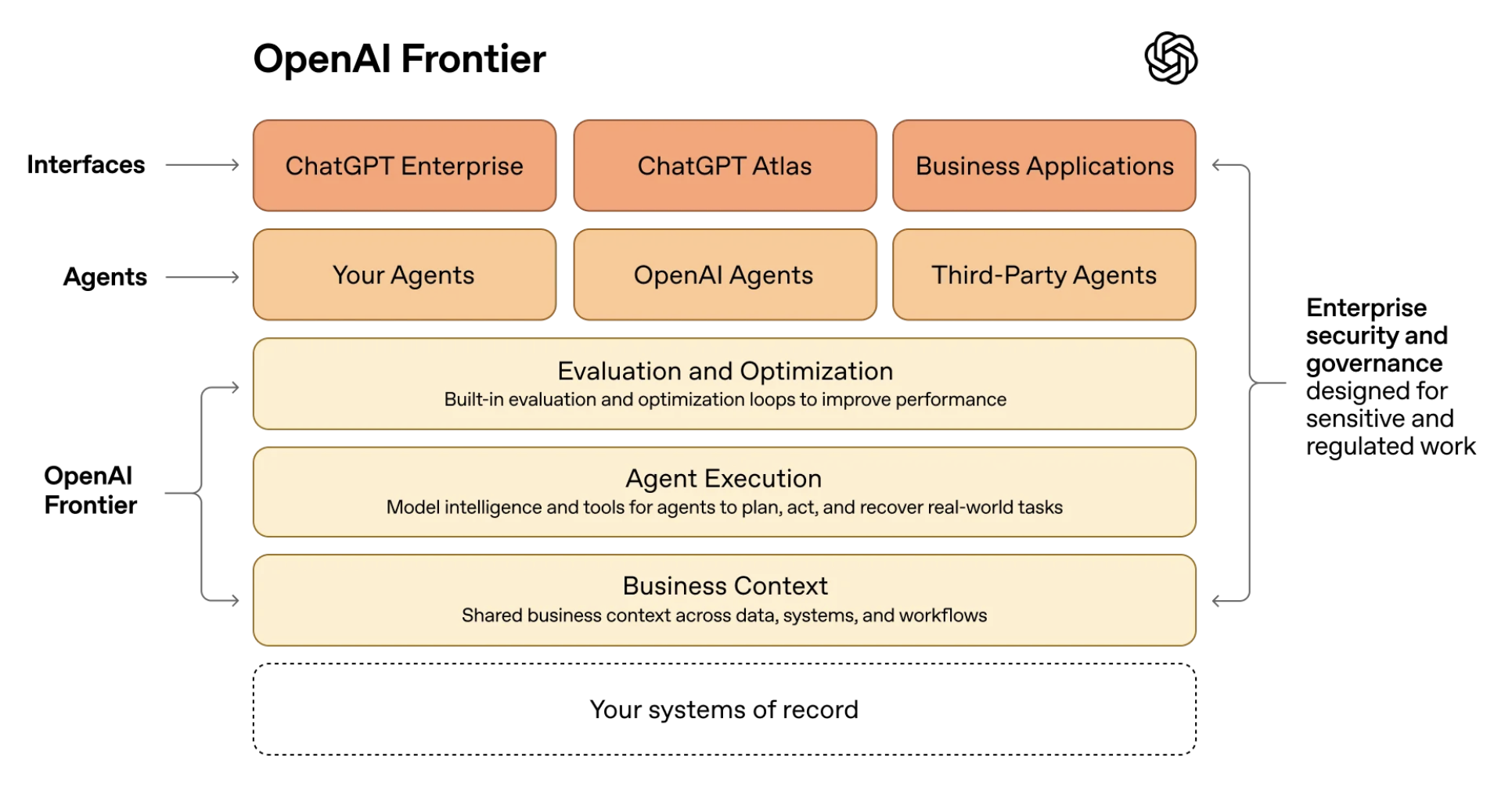
Look at the Frontier architecture diagram. This is not a product diagram. It resembles what a true AI-native organization looks like. One where AI agents handle the execution, coordination, and heavy lifting across every layer of the business.
Here is how each layer works:
-
Interfaces (ChatGPT Enterprise, Atlas, Business Applications) sit at the top. This is where humans interact with the system. They set goals, review results, and make decisions. Think of it as the command center. Instead of logging into ten different tools, a leader opens one interface and tells agents what to do.
-
Agents (Your Agents, OpenAI Agents, Third-Party Agents) sit just below. They coordinate and delegate work across internal and external systems. Notice it is a mix of your own agents, OpenAI's, and third-party ones, just like companies use a blend of full-time employees and contractors. One agent might handle sales outreach while another manages procurement, each pulling in specialized third-party agents when needed.
-
Evaluation and Optimization monitors performance and tightens feedback loops. This is the operations and quality assurance layer. It tracks whether agents are hitting targets, flags errors, and continuously improves how work gets done. In a traditional company, this would be an entire team of analysts and managers reviewing dashboards and writing reports.
-
Agent Execution is where the real work happens. Planning, acting, and recovering on tasks. An agent receives a goal, breaks it into steps, executes each one, and handles failures along the way. This is the equivalent of every individual contributor in the company, from the sales rep making calls to the analyst pulling reports.
-
Business Context holds the shared knowledge, the institutional memory that ties everything together. Company policies, past decisions, customer history, product documentation. Without this layer, agents would operate blind. With it, they make decisions that are grounded in what the organization actually knows.
-
Systems of Record connect to the outside world. Customers, vendors, databases, partner systems. This is where real data lives. Agents read from and write to these systems the same way employees do today, except they do it through APIs instead of clicking through a UI.
-
Enterprise Security and Governance wraps around all of it. This is compliance, access control, and policy enforcement. It makes sure agents only access what they are allowed to, actions are logged and auditable, and nothing violates regulatory requirements. Without this layer, none of the above would be viable in a real enterprise.
That layered breakdown should feel familiar. It maps almost perfectly to how companies already operate:
| Traditional Organization | Frontier Layer | What It Does |
|---|---|---|
| Leadership team | Interfaces | Sets direction, reviews results, makes decisions |
| Managers | Agents | Breaks down goals into tasks and routes them |
| Teams of employees | Agent Execution | Does the actual work (planning, acting, recovering) |
| Operations / QA | Evaluation and Optimization | Tracks performance and tightens feedback loops |
| Internal wikis and tribal knowledge | Business Context | Holds shared knowledge and institutional memory |
| CRMs, ERPs, partner systems | Systems of Record | Connects to the outside world |
| Compliance teams | Enterprise Security and Governance | Enforces policy, access control, and compliance |
The structure is almost identical. The difference is who fills the roles. In a traditional organization, you need hundreds of people across those layers. In the Frontier model, AI agents fill most of those roles.
That comparison is what spooked the market. Not because agents can do tasks, but because of what disappears when they do.
If Teams Shrink and Agents Skip the GUI, What Happens to All the Software in Between?
The whole promise of AI is to boost productivity. Do more with fewer people. But fewer people means fewer seats. And if agents are doing the work instead of humans, they do not need the software the way humans did.
Look at the Frontier diagram again. Frontier is not going after CRM software itself. It is going after the manual sales operations workflows that happen inside those systems.
Think about why SaaS interfaces look the way they do. Every dropdown, modal, dashboard, and multi-step wizard exists because a person needed to see it, click it, and understand it. The entire presentation layer was built for human workers.
Agents do not need any of that. They need an API, a data schema, and clear instructions. No dashboards. No onboarding flows. No pretty UI.
That changes what software is worth. When the end user is an agent instead of a person, the presentation layer that SaaS companies spent decades perfecting becomes dead weight. The value shifts from the interface to the data and logic underneath it. Tools like Salesforce and Adobe become data backends, not user experiences.
When agents replace the workforce, the software built for that workforce loses its buyers. That is why the market panicked.
And the panic showed up fast in the numbers.
The Stock Market Fallout
Some of the hardest-hit stocks:
- Oracle (ORCL): -30.3%
- ServiceNow (NOW): -28%
- Salesforce (CRM): -26%
- Workday (WDAY): -25%
- Adobe (ADBE): -22% to -27%
- SAP: -16% in a single day
- Microsoft (MSFT): -14% (the "best" performer because they are on both sides of the trade)
Smaller SaaS names were already struggling, and the selloff accelerated the damage. Asana sat 92% below its all-time high. DocuSign was down 85% from its peak.
The Goldman Sachs Software Index (IGV) dropped 30% from its October 2025 highs. Apollo and BlackRock reportedly started slashing their software allocations.
Not everyone agrees on what the numbers mean, though.
How the Industry Is Reading This
The discourse falls into roughly three camps.
Camp 1: This Is Real and Structural
Jefferies' trading desk described sentiment as "bearish to doomsday." Jim Cramer warned of "permanent AI obsolescence" for some software names.
On LinkedIn, Venkat Venkataramani (formerly CEO of Rockset, acquired by OpenAI) warned that infra founders "must play offense" because foundation models are "nibbling away at what was traditionally considered infrastructure."
Jason Lemkin (SaaStr) posted about founders at $100M+ ARR leaving their companies to start AI ventures. Even successful SaaS founders are questioning the long-term viability of their own business models.
IDC predicts 70% of software vendors will refactor their pricing by 2028. Some analysts forecast that by 2027, companies might buy an AI "Sales Agent" from a platform provider instead of buying a CRM at all.
Camp 2: The Selloff Is Overblown
Nvidia CEO Jensen Huang pushed back hard: "The notion that software will be replaced by AI is the most illogical thing in the world." His argument is that AI will use and enhance existing software, not replace it.
Wedbush Securities argued that enterprises will not overhaul tens of billions in prior infrastructure investments. Large companies spent decades building trillions of data points into their software stack. That does not get ripped out overnight.
Constellation Research called it a concern about profit pressure and pricing limits, not a death knell. Some analysts called it a buying opportunity.
Camp 3: The Truth Is in Between
Shelly Palmer framed it as "not the death of SaaS, but the death of the assumptions that once made software feel inherently safer than everything else."
3Cubed founder Shammik Gupta argued that "work in a company is more than drafting and summaries. It is deciding what to do, coordinating and influencing people, and owning the outcome. Work remains intact. It gets faster, leaner, and priced on outcomes instead of hours."
On Hacker News, the community was skeptical. Users questioned the gap between marketing claims and actual capability, asking "When can we say we have enough AI? Even for enterprise?"
With all of that context, here is where I land.
My Take
The Selloff Is Overblown, but the Shift Is Real
For the past two years, the market treated AI as a "copilot." A tool that makes existing software better. AI makes Salesforce smarter. AI makes ServiceNow faster. The story was additive. Everyone wins.
In 2026, that story broke. AI stopped assisting and started replacing. Anthropic showed an agent that runs business processes without human input. OpenAI published a blueprint for an entire agent-powered organization. The market realized AI is no longer a feature inside software. It is the thing that makes the software optional.
That shift is real. And the market will not unsee it.
But the selloff is a repeat of what happened with DeepSeek last January, when Nvidia lost nearly $600 billion in a day. The underlying change was real, but the market overreacted. Nvidia recovered. The same thing is happening here. Wiping hundreds of billions over a product launch and a few architecture slides is panic, not pricing.
But just because the shift is real does not mean it will be easy.
Execution Still Matters
OpenAI published a clean org chart where agents slot neatly into roles. Real enterprises are messy. Workflows span dozens of systems with brittle integrations, edge cases, and institutional politics.
An org chart on a slide is not the same as an org chart in practice. Selling to enterprises is hard. Integration is hard. Security, compliance, and reliability at scale are hard.
There is a reason Salesforce has been around for 25 years. A few product launches do not erase decades of enterprise integration overnight.
That said, the real threat to incumbents may not be OpenAI or Anthropic directly. It is the startups behind them. A small team with AI leverage can now build and ship at a speed that was impossible two years ago. They move faster, carry less baggage, and do not need to protect legacy revenue. Incumbents have distribution and trust. But startups with AI have velocity, and in a market that is shifting this fast, velocity matters.
But whether incumbents or startups win the race matters less than how software gets paid for.
The Per-Seat Model Is the Real Casualty
When agents do the work, charging per human user stops making sense. The old math of "more employees equals more seats equals more revenue" breaks down.
This does not mean every SaaS company dies tomorrow. But the pricing model that powered two decades of SaaS growth needs to evolve. The companies that adapt to outcome-based or usage-based pricing will be fine. The ones clinging to seat-based licensing will not.
Billable Hours Are the Next Domino
It is not just SaaS seats at risk. Consulting firms like Accenture and Deloitte built their business on charging for the time their people spend on a problem.
When AI agents can do in hours what used to take a team of consultants weeks, the billable hour gets compressed. The same force that breaks per-seat pricing breaks per-hour pricing. These firms will need to shift toward outcome-based or value-based models, and the ones that move first will have the advantage.
Per-seat pricing, per-hour pricing, the pattern is the same. When agents do the work, the old billing models break. All of this raises a question the market is still trying to answer: is this a crash or a correction?
This Is a Repricing, Not a Bubble
In 2000, the technology was not ready. In 2026, the technology works. Maybe too well for the comfort of existing business models. That makes this more of a repricing event than a bubble popping.
The world is changing. The market has priced it in. But it priced in the fear, not the timeline.
The real question is how fast AI agents move from demo-impressive to enterprise-reliable. If the answer is "within 12-18 months," the current stock prices may be generous. If the answer is "3-5 years," there is time for incumbents to adapt and this week's selloff will look like a great buying opportunity.
Either way, the old assumption that SaaS revenue is durable and predictable just took a serious hit.
And the consequences of waiting are compounding.
The Acceleration Gap Is Widening
A startup with five people and good AI tooling can now ship what used to require a team of 50. A solo founder can build, launch, and operate a product that would have needed a seed round and a dozen hires two years ago.
On the other side, organizations still debating their "AI strategy" or running pilot programs are falling further behind every quarter. The gap is not linear. It is exponential. Every month you wait, the teams already using AI get faster, ship more, and learn things you have not even started exploring.
The same gap is opening up at the individual level. Two engineers with the same title and same years of experience can have wildly different output depending on how well they use AI. The ones who treat it as a core part of their workflow are operating at a different level. The ones who treat it as a novelty are standing still while the ground moves under them.
So what do you do about it?
How to Prepare for the Shift
Rethink the Work, Not Just the Tools
The biggest barrier is not access to AI. It is how people think about work itself. Most people take their existing process and ask "how can AI speed this up?" That is the wrong question.
The right question is: should this process exist at all? I wrote about this in Thinking in First Principles. The people and companies pulling ahead are not just automating old workflows. They are rethinking what work looks like from scratch.
If your mental model is "AI is a faster employee," you will get incremental gains. If your mental model is "AI changes what is possible," you will build things that were not feasible before. That second mindset is what separates the companies thriving from the ones getting repriced.
Invest in Judgment, Not Execution
Agents handle execution. They plan, act, and recover. What they cannot do is decide what matters, navigate ambiguity, or make the call when the data is unclear.
The people who will thrive are the ones who sharpen their judgment, taste, and decision-making. Those are the skills that keep you at the top of the Frontier diagram, not the bottom. The more execution gets automated, the more valuable the person who knows what to execute on becomes.
Build for Agents, Not Just Users
If you build software, start designing for agent consumption. APIs over UIs. Structured outputs over dashboards. Clear data schemas over pretty onboarding flows.
When agents are the end user, the presentation layer stops being an asset and starts being overhead. Make your product something agents can use, or risk being bypassed entirely. The companies that become agent-friendly infrastructure will capture the next wave. The ones that stay human-only interfaces will lose relevance as the workforce shifts.
Start Small, but Start Now
The acceleration gap makes waiting costly. But many people freeze because the scope feels too big. You do not need to transform everything overnight.
Pick one workflow. Automate it. Learn from it. Then pick the next one. The goal is to build the muscle of working with AI before it becomes table stakes. The teams and individuals who start now will have compounding experience by the time everyone else catches up.
Nearly $1 trillion disappeared in a week because the market realized this shift is coming. The panic will fade. The shift will not.
Look Past the Headlines
The "SaaSpocalypse" narrative is too simple. It frames this as AI replacing Salesforce or ServiceNow. That is the first-order effect, and frankly, it is the least interesting one.
The second and third-order effects are what matter. How work gets priced. How organizations get structured. What happens when the basic unit of labor is no longer a person but an agent.
These effects compound. They do not just change one product category. They reshape how businesses operate and how organizations are built from the ground up. That is the real story, and it matters far more than the headlines.
Enjoyed this post?
If this brought you value, consider buying me a coffee. It helps me keep writing.